• Skip to main content
  • Skip to primary sidebar

Thoughts That Come Unbidden Department

You are here: Home / Archives for 2010

Archives for 2010

Control is an illusion

America has a split personality. I say this with confidence as the evidence is all around us.

  • We want less government involvement in our lives yet we happily whiz down roads paid with Federal highway money.
  • We think “entitlement programs” should be slashed, slashed, slashed, yet 40 million people are receiving food stamps, 50 million are on Medicaid, and 4.4 million are on welfare.
  • A vocal number of us are increasingly so concerned about “illegal immigrants,” ostensibly because they take away jobs that could be going to “real Americans,” that some of us are calling for building a huge wall between us and Mexico and we’re even willing to flirt with fascism by allowing police to detain people who can not prove on the spot they are in the U.S. legally yet when the United Farm Workers issued a challenge to Americans to “take our jobs” only 16 people showed up (video) out of the 4,000+ applications they received.

The other, more insidious, indicator doesn’t really appear on the news. In fact, all of the more visible indicators are evidence of an underlying attitude dissonance in American philosophical thought.

Here’s the thing: shit happens. And when I say “shit” I don’t mean just any stuff. I mean bad things, things that are scary, discomfitting, and enraging, and often have a direct, negative impact on the quality of your life. There are two basic philosophical approaches to a series of these occurrences in your life: take them personally or don’t.

Take them personally manifests itself in two ways, the most obvious being the victim mentality that is also so prevalent in American society today – this is happening to me because I’m poor/a different religion/a minority and has nothing to do with my heroin addiction or the fact that I didn’t work in school so I now am not qualified for any job at all.

The other less obvious but in some ways more detrimental outgrowth of the idea that the bad things that affect your life are personal is the idea that everything that happens to you is a direct outgrowth of your choices.

The idea that everything that happens to you is influenced or able to be influenced by you is a meme brought to us by the positivity movement, exemplified by the bestseller The Secret, and it is seductive. Right thought leads to right consequences. Concentrate on money and the universe will give it to you. Project a good attitude and you will attract happy people. But the dark side of this is that all the bad things that happen to you are an outgrowth of wrong thought.

If your job sucks it’s not because Management are being total assholes and giving you no support whatsoever, or better still outright abusing you; your job sucks because you choose to work for a bad employer and the consequences of Management’s misbehavior are under your control. If you don’t get a raise it’s because you didn’t work hard enough or “sell yourself” enough. If you get cancer it’s because you didn’t focus on being healthy.

Despite its seductive nature and the ultimate appeal of the lure of control, and despite the small grain of truth inherent in its philosophy because after all actions do indeed have consequences, the idea that we can control or influence the bulk of what happens to us is utterly false. It places the onus of others’ behavior on the person being affected by that behavior which in and of itself is contrary to its own philosophy.
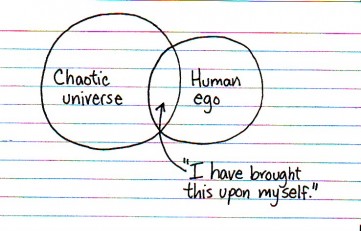
This is Indexed: It’s all more chance than choice. 27 September 2010
Yes, your life is affected by the choices you make and bearing the consequences, both good and bad, of those choices would in a perfect world be your responsibility alone. We don’t live in a perfect world. We live in a world with other people and we are affected by the choices they make not only with no malice toward us but often with no idea of our very existence.

The woman who decides to have a second cup of coffee Tuesday morning which means she leaves the house 15 minutes later than normal which puts her on the freeway at a time when she might not normally be there so she is in the path of the tractor trailer driven by the guy who has been up 40 straight hours to just happens to fall asleep and lose control drifting into her lane and pinning her car against the concrete barrier crushing her to death is affected not only by her choice to have a second cup of coffee but also by the choices of the truck driver, and the person in the lane ahead of her, and by the shipper who put the driver’s load on the truck and set the delivery schedule.

And in the world of The Secret she, and she alone, is responsible for her own death because she chose to have that second cup of coffee.

The simple fact of the matter is that life is chaos. We can control what we can control, which is no where near as much as we think or we would like. But just because life is chaos doesn’t mean that we don’t have a right to bitch about it a little when bad things happen to us. It means that we have to recognize when complaining has taken the place of working to change your circumstances.

Can you hear me now?

Why yes, I can have a dip and sprinkles.

I spent most of the first week in August away at the beach. While it wasn’t perfectly relaxing, being away was relaxing enough that I managed to stem the constant, low-level flow of adrenaline that seems to be my physical reaction to the insanities and absurdities that come with working for a cash-strapped, badly managed non-profit. It wasn’t easy though.

Letting go of all that frustration required walks on the beach, lots of time sitting and reading, good food, some arcade games, and a couple of longish bike rides over flat terrain in a place gleefully accustomed to seeing bikes on the road. It also required that I remember a couple of key tactics for staying sane in a working environment not long on either communication or transparency: dealing with what is instead of what might be, and making everything as much fun as possible.

When we moved office in the summer of 2008 ostensibly the reason for the move downtown was so we could attract more workers to our field canvass and so that it would be easier for the campaign staff we were going to build to attend meetings with other groups and to lobby decision makers. I think it was mostly because one senior staff person was tired of going all the way uptown to the Metro Stop That Time Forgot where there has been virtually no commercial development over the past 30 years and longed for her “glory days” of rolling out of the office and into her favorite dive bar in Dupont Circle.

So my employer signed a 5-year lease securing a suite that takes up the entire 11th floor of an eleven story building just off McPherson Square only a couple of blocks away from the White House, an easy Metro and even easier cab ride to Capitol Hill, and very near a lot of groups with which we work in coalition. And all of that would matter if we’d had the funding to actually add staff.

Oh, we hired a Political Director in 2008 out of the ruins of the Edwards campaign supposedly because he was a super fundraiser who could help us bring in tons of money with his connections. Not only did he not bring in tons of money – in the 6 months he worked for us he did one e-mail fund raising campaign which brought in exactly $30 and the event he organized at the Eastern Shore (Maryland) home of a prominent Democratic Party gadfly cost more to produce than it brought in – he never did anything to shape our external communications to supporters and he only came to the office on pay day which is what will happen when you issue live checks and you’ve hired someone who lives about 80 miles and an hour and 45 minutes away by car.

We also hired a couple of campaign staff people, one to work on global warming and renewable energy, something my organization has a huge problem communicating with our supporters about because our campaigners can’t seem to get the quarter away from their eye long enough to realize that it isn’t the same size as the sun and just maybe everyone doesn’t understand how those issues connect with our primary area of work, and one to work extremely locally with a lot of interested but under served groups in the Anacostia watershed.

But because of the way this organization funds its work, the money eventually ran out to pay the global warming and energy person, and she got fed up with not being able to actually do anything since our national global warming and energy team is lead by someone in Connecticut who is rightfully busy with doing good work on the state level, and the campaigner working on the Anacostia issues decided after about a year that what she really wanted to do was work directly with organizations helping kids.

Since both of them left we’ve got 10 people, several of whom aren’t in the office more than 5 days per month, plus a canvass staff rattling around in space designed to hold three times that many people, space that is costing $60,000 $20,000 a month (still more than double what we were paying uptown) which we don’t always pay on time, and in fact haven’t been current on in nearly a year.

The first step Management took to try to reduce the rent bite was try to sub-let space but, typical of Management’s half-assed approach to things, instead of putting an ad on Craigslist or Idealist.org or circulating it via something like the Progressive Exchange list, they put the onus on staff to come up with potential tenant candidates. When that failed, they started seriously negotiating with the building’s owners and the property management companies (we’ve had two in the past two years) about either dividing up our space on the 11th floor or about moving to another available suite.

Needless to say, our landlords aren’t making the process easy. One of my co-workers, currently on the outs with our ManagingDirector who is in charge of the DC office, told me that they are demanding a ton of fees to move to another, smaller suite. These fees include a penalty for breaking our lease on the larger suite, a moving fee, a renovation fee, and other assorted charges priced in such a way that it would take micro fine accounting to determine that moving was financially to our benefit. Yet, I’m sure that’s what Management is going to decide to do.

Monday afternoons I have a weekly, half-hour call with my direct supervisor who just happens to be in Philadelphia. Calls are pretty standard, we go through the work plan I’ve sent him earlier in the day starting with what meetings I have scheduled, progress on the project from hell, e-mails I’ve gotten requests for from our state offices, updates to the web site, data hygiene on our online supporter database, and anything else that he might have for me that I don’t know about.

It was during this “anything else” section that he mentioned that I may have “heard some scuttlebutt around the office about us moving down to the 4th floor” to which I wanted to reply that while it was no secret that we were looking to move it was unlikely that I’d heard anything specific while I was 125 miles away at the beach. Apparently it’s looking like we’re going to move at the beginning of October to a smaller suite and while the details haven’t been worked out yet, it’s firm enough for him to be relaying this information to me.

Now, there are a ton of things wrong with this plan, one of them is that half of us (including me) will be moving from the sunny front of the building  to the dark back of the building, you know, the part that overlooks the dumpsters in the alley instead of having a partial view of McPherson Square park. That change kinda makes the fact that we can open the windows in our offices sort of a moot point.

From what I have heard in the past four days, there are lots of other things about this move that suck outright. One is the fact that the “renovations” the building’s owners want to charge us for extend solely to adding a suite door in the hallway and taking out a non-bearing wall so we can have a reception desk just inside the new door. They don’t include repainting or recarpeting, and, most importantly, they don’t include adding any sort of kitchen area.

No kitchen area means no place to wash dishes which means everyone is going to be using plastic ware and disposable plates which is more than slightly hypocritical for an environmental organization. And considering that the previous property management company took 6 months (December to May) to respond to a trouble ticket about a broken heater in my office, what are the chances that this new suite is going to be anything vaguely resembling not totally gross?  I think they’re pretty freaking slim.

The other thing that sucks outright is the fact that we’re going to go from individual offices not to an open work plan, which I could totally deal with, but to shared office space for a staff used to having not only their own physical and aural space but also control over the temperature in their immediate environment.

So we’re going to from a newly renovated suite with less than two year-old paint and carpeting, a functional kitchen area, and a situation where staff have basically private offices with individual climate control to a suite with who knows what on the walls and the floors and no place to wash dishes or even a nook for a refrigerator and microwave. I guess I shouldn’t be surprised since no one who makes the decisions has to work in the space.

And I probably shouldn’t be complaining; lots of people have to work under even worse conditions. I also probably shouldn’t be upset by this because none of it actually is yet; we’re still only at the speculation stage. This is where dealing with what is instead of with what might be comes into play.

The co-worker who normally keeps me informed about these things has been cut out of any unofficial communications because she “causes drama around the office” which is just a bullshit way of our ManagingDirector saying that my co-worker actually tells people what’s going on which puts the ManagingDirector in a position of not being  in control of the information flow. This is where making everything as much fun as possible comes into play: I’m running an organizational communications experiment.

It was August 9, 2010 when my direct supervisor informed me that it was likely that we would be moving down to the fourth floor at the beginning of October. That’s 37 work days until October 1 for people who have been in offices two years to sort through and pack up not only their personal workspace but also the rest of the office.

When do you think the official announcement is going to be about a beginning of October move? My bet is on some time the week of September 20th; if they send it out that morning that will give us not quite 9 work days to sort through and pack everything up.

Given the way Management communicates, I think I’m being generous in my estimate. There’s part of me that hopes I’ve underestimated them. What I do know is that it will be interesting to watch.

Quote of the Day

I’m undoubtedly a liberal, which means that I’m in almost total agreement with the Eisenhower-era Republican party platform.
– Rachel Maddow, May 6, 2010, “Wonk and Circumstance”, The Valley Advocate.

While they may not break bones, they do still matter

Slovenly language corrodes the mind.
– John Q. Adams

I freely admit that I am a linguistic pedant. I care about how people use words, what words mean and how definitions are ignored or manipulated. Punctuation matters deeply to me, and someone’s written grammar can influence my abiding opinion of that person in the face of many other positive indicators. This is why I get so frustrated when supposedly intelligent people use language in ways that are just plain wrong.

screen capture from Facebook...with strategic blurring
Because if I reposted this exchange as text it would be searchable.

The whole point of Facebook is to share content: what you’re doing; links you find interesting; notes and funny cartoons; and other effluvia about your life. Facebook’s share module allows you to post a personal note with anything you share to, theoretically, make it more relevant to your circle of friends.

A former co-worker/Facebook friend of mine is a self-proclaimed liberal feminist. She has lots of political hot button issues about which she routinely posts articles. These hot button issues include: oppression of women in any form (about which she comments something along the lines of “It’s the PATRIARCHY!“); how bankers and the rich are totally screwing the American public (usually accompanied by some comment about how this justifies walking away from your mortgage); homeopathic medicines (insert angry medical rant about the harmful fraud they are); and, of course, racial injustice (some meant to be ironic comment about how we all don’t totally ignore racism at every turn).

In the past few days her interest in American culture’s embedded racism has manifested itself in her posting of articles about the Oakland transit cop who shot an unarmed teenager and, just today, about the New Orlean’s police officers charged in the shooting deaths of civilians on the Danizger Bridge in the aftermath of hurricane Katrina in 2005. It’s the personal comments with these postings that have activated my not so hidden inner pedant.

Connotatively, we’ve all got an idea of what an execution looks like and, hence, what it means. Our mental picture probably involves screaming mobs and guillotines, or possibly one blindfolded guy standing against a wall with a lit cigarette in his mouth. But I’m willing to bet that for each of us that connotative definition of execution involves the element of judgement by some judicial authority, valid or not, prior to death.

Denotatively execution has a specific meaning as a noun and execute has a specific meaning as a verb. Both the Oxford English Dictionary and Merriam-Webster agree that when it comes to the meaning of the word execute in relation to killing some legal sanction or political motivation must be involved. For the purposes of this discussion we’re going to ignore the “or for political motivation” aspect of this definition as that implies some sort of organized political rebellion like, oh, the French Revolution.

Legal sanction in these definitions means that the decedents were first involved in some official process that passed judgement on them for violating established laws the outcome of which was a sentence of death that was then carried out with the full weight and authority of the system of laws in our country. Legal sanction implies within the framework of an established legal system. “Legal sanction” does not mean that a BART police officer or a couple of New Orleans PD members decide they don’t like the way someone is acting so they have the authority to decide on the spot to kill them.

But wait, what about the idea that yes, police do have the authority to decide if someone is a threat and to use deadly force to stop an individual? Isn’t that legal sanction?

Yes, it’s legal sanction of a kind which gives judicial seeming authority to individual police officers in the face of manifest deadly force on the part of another individual but if the police had perceived and it could be proven that the decedents were exhibiting such deadly force there would be no judicial trials around these incidents, no actual legal sanction against the officers involved. Everything would be handled administratively and none of these officers would be making their way through the court system. In the particular case of the transit cop in Oakland, video tape of the event, produced by four witnesses, cast enough doubt that the decedent exhibited deadly force that the transit officer involved was tried on a charge of murder.

So, since no legal sanction, either judicial or, for lack of a better classification, administrative was involved in any of these killings, which is specifically the point of the articles on both these incidents, it seems to me to say that the decedents were “executed” is patently incorrect and is being done, quite frankly, for unnecessary shock value.

Sociologists, psychologists, anthropologists, economists, and pop culture mavens have noted a trend in the past few years: we tend to restrict our information gathering to sources that already agree with our established opinions. This isn’t surprising given that we tend to form friendships with people who believe similar things as us. Social networking merely highlights this propensity.

Now, if your social network, which already holds similar positions as you do on a wide variety of issues, is so jaded that the idea of police officers murdering unarmed individuals isn’t shocking enough and you’ve got to resort to using the word “execution” to get their attention you’ve got some serious problems. What really bothers me, though, is not just that she is abusing the language for shock value but that she selectively decides when words are important and when they aren’t.

This is a woman who insists on politically correct language when it comes to anything relating to feminism or “women’s issues.” Precision is paramount and yet I’m being asked to “not split hairs,” which is, by the way, just a more polite way of saying “stop being so argumentative” which is something that men often tell women when they want us to just STFU, when it comes to characterizing something as a state sanctioned killing (an execution) versus a murder (a killing outside the law often punishable itself by state sanctioned death). Really? Really?

It also bothers me that this supposedly smart person doesn’t know the difference between a Google search result for a word definition and the definition provided by The Oxford English Dictionary (it’s a link to an “online dictionary” after all).

Maybe I’m giving her too much credit in the intelligence department. Maybe she really believes that our system of laws actually backs up a police officer any time he shoots an unarmed civilian. Maybe she actually thinks that these killings were political acts rather than fear or frustration responses. Maybe she actually doesn’t understand the difference between these ghastly murders and when someone violates our laws, is caught, and a structured system passes judgment on them that the crime was so heinous and the chances of a similarly heinous crime being perpetrated again by the same individual are so great that the only reasonable punishment is death.

Both these incidents, the one in Oakland and the one in New Orleans, were absolutely horrible and I’m in no way justifying or supporting the actions of these police officers. Videotape in the Oakland incident proved to a jury that the teenager who was shot to death likely wasn’t posing a deadly threat and the cover up of the facts surrounding the shootings on the Danizger Bridge leads one to believe that the officers involved knew they did something wrong.

Quite frankly, I’m not a supporter of the death penalty any more either. I think that you should have to work a lot harder to get sent to prison than you have to work now, that prison should be a lot more uncomfortable than it really is, and that there are some crimes that are so repulsive the only way justice will ever be served is if the relatives of the victim get to poke the perpetrator to death with sharp sticks over the course of several days. But even though I don’t agree with it, my country has the death penalty in many places which means it’s important to make a distinction between killing we allow and killing we punish.

So while I don’t disagree with her ideology, perhaps my inner language pedant has provided a path for me to see my “friend’s” political outrage for what it really is: hypocrisy. And that is something that bothers me more than abuse of the language.

* Edited to remove snarky <acronym> comment about homeopathy.

$200 is a lot for a demo, especially if there’s no free delivery

I miss my bed. I really do. For the past four days it has been near or over 100degF here and I’ve been sleeping on the sofa bed in my living room. Why? Simple: the air conditioner in my bedroom sounds like a jet engine spooling up for takeoff, and that’s from downstairs in the living room.

My house is 85 years old and doesn’t have central AC. When I moved in I priced a retrofit central air conditioning system, the kind with the circular flexible ductwork, and the sales guy took a look around my empty house and told me that because I had “lots of room in the closets” it was going to be a low cost job, only $15,000.

Do you know how many window units you can buy for $15,000?

In the 14 years I’ve lived in this house, I don’t think I’ve spent even a quarter of that on air conditioners. But lately I’ve been looking into a replacement for the one in my bedroom even though it’s only 2 years old and even though I paid way too much for it in the middle of a heat wave.

I’ve delved into Consumer Reports’ reviews of window units, which aren’t dated by the way, so I have no idea if we’re talking about a review of a model year that was manufactured here or somewhere else. Not that it especially matters where something was manufactured, but ac units, particularly window units, have gotten more cheaply made and with shoddier workmanship over the past decade.

I’ve looked at customer reviews on a dozen rating sites and vendor sites calculating number of stars on top of a rating base balanced against the age of the reviews (4.5 stars out of 5 on a base of 20 reviews isn’t worth much if the most recent review is two years old). I’ve considered my pocket book and my comfort, and I have, in theory, found the perfect air conditioner.

Friedrich Kuhl. It comes in neat colors but with a suggested retail price of over $1,000 I really want to be able to check out a demo model before I buy.

The Friedrich Kuhl line is not only pretty but it’s highly ranked for energy efficiency, capacity, and, most importantly, quietness. Unfortunately, the Kuhl line is not cheap, as in $958 from the nearest authorized dealer which I found out when I called them this afternoon. And while I don’t normally balk at paying for quality merchandise, especially quality merchandise that helps me get a good night’s sleep, what I do balk at is vendor policies that seem like a blatant rip-off.

If I’m paying $958 for an air conditioner which you don’t have a floor model of that I can test in your store, don’t you think a 20% restocking fee is a bit unreasonable? And more to the point, does it really cost you more money to restock a $958 air conditioner than it does to restock a $375 dishwasher?

So, the next best thing: a trip to Home Depot this weekend to look at and, hopefully, buy a $350 LG window unit which, if it sounds like a jet engine taking off when I get it installed and turn it on, I can return for no fee with no questions asked.

  • « Go to Previous Page
  • Page 1
  • Interim pages omitted …
  • Page 6
  • Page 7
  • Page 8
  • Page 9
  • Page 10
  • Interim pages omitted …
  • Page 12
  • Go to Next Page »

Primary Sidebar

Looking for fiction?

Read the fiction blog for stories less topical and more diverting.

Categories

Archives

Copyright © 2026