Nov
30
2008

Recipe for life

One of the key rules of blogging is that no one wants to know what you had for lunch. Unless you’ve focused your blog around your culinary adventures, writing about your meals is the refuge of the lazy blogger. That said: I made a culinary advancement this month.

Eggs are one of my favorite foods. Scrambled, fried, combined into the French farm wife’s dish of choice, I’ll eat eggs for any meal at any time of day. Despite my love of just about all dishes egg-related, I’m not very good at cooking them. However, one Sunday morning this month I discovered the secret to the perfect omlette: fat, heat, water, and patience.

You have to put enough fat, I used real, actual butter, in the pan, let it get hot enough before you pour in the eggs which you have already mixed with just enough cool water that vigorous mixing with a fork produces a slight froth around the edge, and wait just long enough for the eggs to form a good, solid base before you move the edge aside to let the mixture on top get near the pan and start to cook. The patience comes in when you turn down the heat from high to medium and cover the frying pan with a lid giving the base enough time to solidify and the mixture on top enough heat to cook.

And while I was enjoying my omlette with cheese and reading through the Sunday paper it hit me: the things that are necessary for making a good omlette are the same things that are necessary for a good, rich life.

You need to have a little fat in your life for those times that are physically or emotionally lean. Sure, being fit and in shape is fine but if you hew to the body trends of the day you’re constantly hungry, constantly stressing out your immune system, so that when hard times do come they sap your core resources and not that little bit extra that you’ve got hanging around as your cushion.

A well lived life, a full life means heat. It requires passion even if it is only the fire of righteous indignation at the stupidity of the world and the people who live in it. You have to be careful, though, to make sure that your passion is yours, that it’s productive rather than totally reactive; too much of that righteous indignation dampens real fire quick as anesthetized boredom ever could leaving you hollow, sour, and small.

New things, places, people, and experiences marinate your life and your view points in a soup of input that without enough of you dry up. Your mind shuts down and you think the things you think are the only things that should be thought. Not enough flow, not enough wetness and your bones crumble, sediment settles as its wont to do, and you stagnate.

And then there’s patience. Patience is the hardest one to figure out when trying to construct a personal “good life” strategy. Any adult knows that not only is it not practical it’s often not even possible to have everything you want right at the moment you want it, but how long to wait? How long to bide your time, to stay in a job that doesn’t quite fit but isn’t really that discomfiting, in a relationship that isn’t perfect but then again what is, in a life that isn’t entirely fulfilling but who promised you that life would be easy or even satisfactory? When do you act now and when do you wait realizing that while tomorrow isn’t guaranteed neither is the idea that there won’t be a tomorrow for you and if there is you’ll have to deal with the consequences of today?

I find myself nearing the end of my fourth decade with little left but patience. Shut in, shut out, dry and humorless, every knock, dig, dent, and ping taking more out of me than I think it should.

Maybe it’s just aging, the natural disconnection of the childless and middle-aged from popular culture the irrelevance and recycled nature of which becomes clearer and clearer with every fashion and music trend.

Or maybe, just maybe, I need to find some matches, to stop considering my options so that what needs to be done and what is expected of me always precede what I want whenever there is a choice to be made.

Possibly it’s just the holidays. Maybe if I can crawl into a cave until the teeth cracking sweetness of public music and the wallet busting desperation of the retail machine have passed I’ll be OK.

It feels deeper than that, though. The leeching in my life, the lack of fat and heat and juiciness, seems dug in, here for the long haul.

It’s time for a reboot. How I’m going to do that I don’t know, but it’s definitely time.
Nov
29
2008

Miss Oblivion

It’s feeling like this that makes you wonder how many pills are in the cabinet.

Feeling like your skin doesn’t quite fit, an itchy, crawly restlessness that no amount of motion will shake off: too hot; too cold; too bright in here; it’s too dark to read in this light; why did I pick this book anyway; it’s breakfastlunchdinner time and yet I’m not hungry but McDonald’s sounds like a good idea.

Nothing works, nothing fits, and there is no solution to this cross, crabby feeling, like you woke up 30° off center with the entire universe. You don’t mean to snap at your relativegirlboyfriend who really truly just want to make you feel better but you don’t have access to anything except this bubbling, formless discomfort. Puking it out on to them in snappish tones, sarcasm, and rolling eyes doesn’t help either as it’s endless, like a gas that just expands and expands and expands to fill whatever space is available inside you ballooning you to twicethreefour times your normal size even though part of you feels as small as a dried up pea that rolled under the couch and isn’t discovered until the lease is up, the furniture moved, and the place is getting cleaned to get back the security deposit.

It’s feeling like this, among other reasons, that people seek the oblivion of the nod, the high, the confidence that a snort or two from one of those bottles in the cabinet seems to bring. It’s why so many of us overspend, overeat, yell at our kids, and watch too much TV.

Narcotized we stumble through our lives not searching for the answers, not looking inside to figure out why we feel like this but instead howling like infants who just want the pain, discomfort, and fear to go. away. not realizing that this, this feeling like nothing fits, like nothing will ever be right again is an opportunity, a chance to find out what is here at off-center and whether or not we want to stay.

It’s feeling like this that makes people think oblivion is a better alternative even if it is only the temporary kind.

Nov
28
2008

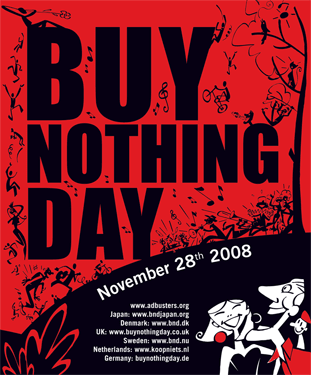
Buy Nothing Day

Buy Nothing Day 2008, red, U.S. version

Get more information about Buy Nothing Day at Adbusters

Some extremely self-righteous folks will tell you that “buy nothing day” means just that: buy nothing. Don’t use the Internet (that’s buying access), don’t watch cable (that’s buying TV), don’t go to the movies, eat out, go to the grocery or make a trip to the hardware store.

Those of us without our heads firmly planted up our asses realize that the intent of buy nothing day is to remove us from consumer culture, to actively decline to participate in the locust like devouring of resources and trashing the planet.

So today while I will put money into the economy in the form of doing my regular, weekly grocery shopping (seriously, do kitty litter, milk, eggs, and maxi pads contribute to consumer culture?) I’m also not rushing out to the mall to buy a lot of stuff that I don’t really need and have no place to store.

Nov
27
2008

Gratitude

I am grateful for my life, not just the good parts but the bad as well. They may suck while they’re happening but at least they mean I am still alive.

But isn’t it better to be grateful daily than to be a bastard most of the time and save up the goodness for the “holiday season?” The Washington Post published a blurb in today’s Business section about gratitude in the workplace:

If you haven’t thanked a co-worker this week, you’re behind on your gratitude quota. That could cost you professionally and personally.

Gratitude can inspire workers to produce: an Adecco/Harris Interactive survey last year found two-thirds of respondents in their 20s and early 30s said they work harder if they get more thanks.

And those who dole out thanks are more energetic, healthier and have more connections with people, says Charles D. Kerns, a Pepperdine associate professor of applied behavioral science. Citing his own and others’ research, he notes that gratitude enhances optimism and reduces stress.

He distinguishes gratitude from performance rewards such as bonuses. Gratitude is more personal and creates a positive culture.

Gratitude also fosters goodwill, loyalty and productivity, all of which could be valuable in a poor economy. “The expression of gratitude may help one adapt to life’s challenges,” Kerns says.

“Gratitude is one emerging area . . . that appears to have a place in the workplace to help produce happy high-performers.”

And that’s true every day, not just on Thanksgiving.

- “Working,” by Vickie Elmer, The Washington Post, Thursday, November 27, 2008; Page D02

and given that we go this from our BigBoss yesterday:

You. I am grateful that I get to work with all of you and that we had a successful year, even if we had to fly by the seat of our pants for most of it. Thanks for all of the great work you all do every day.

[Our organization] has an amazing team. I’m thankful to be part of it.

I would say most of us know these things to be true.

So, make a resolution to say thank you to someone you wouldn’t normally say thank you to: the person who makes your sandwich at Subway, someone who holds the door for you on the way into a public building, your spouse or roommate when she does something that really is her chore to do anyway, and see how it feels. Before I go bake cheesy bread I leave you with this:

Nov
26
2008

Heterosexual does not equal happy

Hollywood is never kind to women who have sexual or romantic relationships with other women. Whether it’s on film or TV, lesbians or bisexual women often turn out to be villains and frequently end up dead at some point during the course of the script. The Children’s Hour (1934 and 1961) to The Fox to Basic Instinct on the silver screen are but a few examples of films in which a non-hetero woman ends up demonized or dead at worst, or no longer in a same-sex relationship at best. Personal Best, long held up as example of forward progress for its portrayal of a female same-sex relationship, ends with the main character in a relationship with a man. Television treats women who express same-sex affection no better.

Television excels at portraying women in same-sex relationships as desperate in their deviance: from 1977′s In the Glitter Palace in which a bisexual woman asks her former boyfriend to defend her lesbian lover against murder charges to My Two Loves in 1986 in which a woman grieving the death of her husband is coaxed into a same-sex relationship to the otherwise imminently wonderful Battlestar Galactica in which the Number 6 models are entirely flexible when it comes to their sexuality and their desire to exterminate the human race.

More often, though, same-sex expressions of sexuality or romantic feeling are portrayed as acts of desperation engaged in by women who aren’t in their right minds, women who, once they are on the “right” path manifest realization of the error of their ways and the regaining of their sanity through relationships with men.

I had hoped, though, that after Ellen, in a TV season with the highest number of gay, lesbian, bisexual, and transgendered characters ever seen on television, that we had grown past the lesbian relationship equals unhappiness/heterosexual relationship equals happiness dynamic. Tuesday I learned that, unfortunately, we have not.

Be Warned: Here There Be Spoilers

*
*
*
*
*
*
*
*
*
*
*
*
*
*
*
*
*
*
*
*
*
I watch House M.D. for a number of reasons. I like Hugh Laurie. Gregory House is an annoying, fascinating character who violates all principles of social etiquette and is allowed to get away with it. The show routinely features good dialogue that sets a disturbingly high bar for how real people might talk. The past two seasons, though, have showcased House’s new team which includes the bisexual Thirteen (aka: Dr. Remy Hadley) played by the entirely not hard on the eyes Olivia Wilde.

If you don’t follow the show the thumbnail sketch is this: after many shenanigans last season Thirteen finally gives in and gets a DNA test to find out whether or not she has Huntington’s disease (degenerative disorder that results loss of mental faculties, uncontrolled movements, and emotional disturbances). Her positive diagnosis results in some rather nihilistic behavior: drug taking, sex with a lot of random female partners, and generally cranky disinclination to do anything to ameliorate the on-set or severity of the disease. Basically, after learning she’s only got about a decade to live, Thirteen has essentially given up on life. That is until last night.

Last night’s episode involves a gunman who takes House, Thirteen, and several patients hostage in his desperate search for a diagnosis. Long story short: we end up with a scenario where, after some failed trickery by House, the gunman forces Thirteen to take first every medication House says he should take to make sure they aren’t knockout drugs or something fatal.

By the end of the episode, Thirteen is going into renal failure and the last drug could, potentially, kill her. Her revelatory moment – that she doesn’t want to die – comes with syringe in hand and a gun to her head.

Over the course of the season Dr. Eric Foreman (Omar Epps) has been pestering Thirteen about her treatment regimen, or lack there of, and by the end of last night’s episode Thirteen is prepared enter herself in a clinical trial of a new Huntington’s drug that Foreman is running, a trial she refused to even consider before the hostage situation and her revelation.

It was a good episode overall, dramatic, interesting, and showcasing the characters that I like. And then I opened up last week’s Entertainment Weekly and read this in “The Ausiello Files“:

Q: Any exciting surprises coming up on House? —Yolanda
A: Yes, and they all seem to be jammed into the Dec. 9 episode. In addition to the first-ever smooch between budding lovebirds Foreman and Thirteen, the holiday-themed outing also boasts a show-altering twist that is nothing short of a miracle. A true-blue spectacle, if you will. A miracle come true. (Hint: It doesn’t involve a Barry Manilow cameo. I swear.)

Now, I get that House is a drama that thrives on tension between the characters, and nothing breeds more tension in a workplace environment than two characters having sex (or romance). And as a writer I get why they’d pair these two characters up: House is a male dominated show; the only two other female characters, Dr. Allison Cameron (Jennifer Morrison) and Dr. Lisa Cuddy (Lisa Edelstein) are already spoken for. Introducing another female character wouldn’t work: that tension wouldn’t exist with a new character.

From a character development perspective having Thirteen get involved in a romantic relationship now that she’s out of her nihilistic funk makes sense as well: nothing says “life” like love (or sex depending upon how much of a romantic you are).

But no matter how much I understand it as a writer and as someone used to analyzing texts, it still irks the living shit out of me that now that Thirteen is ready to embrace life, now that she’s admitted that she really does care about whether she lives or dies, they’re pushing her into a relationship with a guy.

I guess we’re a far cry from The Children’s Hour but the continued equation of lesbian relationships with miserable, self-destructive deviance seems to be hanging around like the odor of rotten fruit.

Nov
25
2008

You don’t want to hire me, do you?

I loathe job interviews. They are, in fact, the thing I am worst at: selling myself.

I’m not sure if I’m bad at this because I’m an introvert (yes, I know, all evidence to the contrary) or because I am, at base, somehow convinced that I’m ATAABOC and just don’t understand why everyone else doesn’t immediate perceive that and judge me based on my concrete achievements rather than whether or not I hold up well under direct questioning. I’m going to go with some of both, heavily weighted toward the introvert explanation.

The thing is, when a job interview goes really bad, I can usually tell. Like one I had a couple of years ago where the department supervisor asked me how I would handle on a Monday morning the work flow on:

  • a press release for a press conference happening that afternoon.
  • a request for a web site update from a department that hadn’t updated their content in 6 months.
  • a change request for something that was incorrect on the site.
  • a request from a senior manager for training a new staff member.

If I didn’t know it was physically impossible I would say that a sign lit up over my head that read “I’ve got 8 years’ experience in my field and you’re asking me how I’d prioritize these tasks. You’re shitting me.” Regardless, that was the moment that I not only blew my chances at that job but also decided that I didn’t want to work there anyway.

How today’s went, I don’t know. I just keep reminding myself: I am interviewing them as much as they are interviewing me and anyone who hires me is lucky to get me. I’m not perfect (no one is) but I’m damn good.

Nov
24
2008

Occupied

I’ve had house guests since 5:05pm Friday night.

They were an hour early.

I had to get up at 4:45am today to get any privacy…in my own house.

And look, Thanksgiving is just around the corner: Thanksgiving which means socializing with my entire family for a whole day.

I feel like someone has been hitting me with a stick for three days.

On a brighter note, I spent Saturday doing the tourist thing downtown which is often nice. It makes me see my hometown in a different light. It also makes me realize that I take a damn fine postcard photo. A brief photo tour of the Mall…

Pretty, but it still reminds me of a big birthday cake.

Pretty, but it still reminds me of a big birthday cake.

The centerpiece of the Memorial

The centerpiece of the Memorial

Many talk of the detail in Lincoln's face.  What has always impressed me more is the flow and folds of his clothes.

Many talk of the detail in Lincoln's face. What has always impressed me more is the flow and folds of his clothes.

Down the mall to the Washington...aka the I have a dream... POV

Down the mall to the Washington...aka the I have a dream... POV

You couldn't see it in the wider shot but these geese covered the reflecting pool.  In the far, far background: the Capitol.

You couldn't see it in the wider shot but these geese covered the reflecting pool.

They are by no means small animals. If I'd had bread products on me I would have been scared.

They are by no means small animals.

Many thought the World War II Memorial would destroy the Mall's vista.  Now that it's up, I think they did an excellent job with the flow of it.

Many thought the World War II Memorial would destroy the Mall's vista. Now that it's up, I think they did an excellent job with the flow of it.

All around it are these friezes showing scenes of the era.

All around it are these friezes showing scenes of the era.

And quotes...this is one I particularly like.

And quotes...this is one I particularly like.

The White House from the elipse (don't stick your hand through the fence).

The White House from the elipse (don't stick your hand through the fence).

The great thing about monumental Washington is that you can see everything from everywhere.  This is the view from the White House. In the far distance, looking like a roll-on deodorant: The Jefferson Memorial.

The great thing about monumental Washington is that you can see everything from everywhere. This is the view from the White House. In the far distance, looking like a roll-on deodorant: The Jefferson Memorial.

And the view of the White House from the Avenue.

And the view of the White House from the Avenue.

For a break from monumental art: one of my two most favored sculptures from the National Gallery's sculpture garden.

For a break from monumental art: one of my two most favored sculptures from the National Gallery's sculpture garden.

Nov
23
2008

Subject verb predicate

I like language a lot. It’s flexible and mutable. Really, language is a living thing influenced by time, place, and context to a degree that almost no one comprehends while they’re actually using it. But a letter I got in the mail Friday got me to thinking about the limitations of language and how we use it. Take sand.

Because we don’t live in Dickens’ circumscribed world all a writer has to do to give you a picture of sand is use the word sand. Chances are even if you’ve never been to a beach you’ve probably seen a picture of one or seen one in a movie which means the word sand has, at least, denotative meaning for you. Sands of time, sands through the hourglass, sandy shores, all of these are idioms that conjure up what Merriam-Webster rightly and rather blandly describes as “a loose granular material that results from the disintegration of rocks, consists of particles smaller than gravel but coarser than silt.”

But what color is it?

See, here is where how we use language gets interesting. One of the denotative definitions of sand is “a yellowish-gray color.” Except that depending upon your experiences sand can be black, red, white, green, or pink.

What I find curious is not that we limit the word sand to a single color when the actual article the word describes manifestly comes in more hues. We limit the definitions of words all the time – obscene and p*rn*gr*ph*c to pick the two most egregious examples. No, what peaks my interest is why we limit definitions.

Is it because the other instances of a particular thing – like a black sand beach – are so specific and rare that by the time someone found one sand was being used to describe the most common sort, you know, the kind that comes in varying shades of tan, that the only thing to be done to describe this new place was to prepend a color to the word sand?

Or do we limit the definitions of words because this great thing we invented to communicate with each other actually outstrips our abilities as a species to use it to communicate? Are complex ideas starting to exceed our capacity to understand them?

I like to think my facility with language is on the high end of the scale for my time and place. I certainly can’t compare to some of the giants in the field who spend their lives studying words, using words, and sussing out what words mean in different contexts but that doesn’t keep me from being interested in how we use them.

And just for your amusement I provide the following: “Obama’s Use of Complete Sentences Stirs Controversy; Stunning Break with Last Eight Years

Nov
22
2008

By their deeds

Someone please tell me why I should spend one second being tolerant of Islam or give a shit about Africa?

From the November 21, 2008 edition of The WeekThe World At A Glance…International” :

Kismayu, Somalia
Rape victim stoned to death: Islamic fundamentalists brutally executed a 13-year-old girl who was convicted of adultery for being raped by three men, the United Nations confirmed last week. Aisha Ibrahim Duhulow was visiting her grandmother when she sought out the rebel militia that controls the city of Kismayu to report that she’d been raped; that amounted to a confession in the eyes of the sharia court. “The evidence came from her side and she officially confirmed her guilt,” said the presiding cleric, Sheikh Hayakalah. Duhulow was reportedly dragged screaming into a soccer stadium in front of crowd of 1,000 people, buried up to her neck, and stoned for more than 10 minutes by 50 executioners. Militia members fired on a few people who tried to intervene, killing an 8-year-old boy. The rapists were not arrested.

Yes, I know Christianity’s history is not unblemished with similar crimes. This just encourages my belief that organized religion is the least beneficial thing human beings have ever invented.

And yes, I understand academically that the only way to make change is to make change, to try to educate people, to try to help those whom others would hold down, but what’s the point at which it’s OK to just throw up your hands and abandon people to their own greed, stupidity, and well, evil? At what point to people just become beyond reform?

Today is one of those days when I agree with Ellen Ripley: Let’s take off a nuke the site from orbit. It’s the only way to be sure.

Nov
21
2008

Memory error

Consider death for a moment. Americans have this tendency to view death as tragic without really thinking about why we shake our heads and make that soft clucking sound in the back of our throats while our eyes refuse to light anywhere because actually making eye contact might force us to acknowledge another human being’s raw feelings.

I think that a lot of times someone’s death is seen as tragic because we dwell on the cessation of the deceased’s experiences – that the 16 year-old killed in the car accident will never grow up to find love and live a a full life; that the child died before she got a chance to mature; that the middle aged woman will never see her kids grow up to do all of those things that we expect parents to be proud kids do (Random question: How come no one ever says “Thank God Linda died of cancer before she could see little Billy become a junkie with AIDS?” ’cause not every kid is going to grow up to be president and sometimes that’s pretty damn obvious…but I digress).

We fail to realize that death is the natural end of the cycle. Jim Morrison may have been a narcissistic lush but never a truer line was written than “no one here gets out alive.” Or, as Chuck Palahniuk wrote, “On a long enough time line the survival rate for everyone drops to zero.” And while I’m not saying it’s wrong to grieve the deceased’s lost experiences, there is an unspoken thread there, a fear so primal that I think it takes years, if ever, before any of us realize that it’s there.

Though I was first introduced to it as a concept of Judaism it wouldn’t surprise me to find out that other religions incorporate the idea that a loved one isn’t really gone as long as she’s remembered by someone still living. It’s a comforting concept that just by cherishing your loved one’s memory you carry a little piece of that person around with you for as long as you live anyway. In many ways it mirrors the reality of our experiences; the people we care for, whether we loved them or hated them, influence our decision making processes and our outlook on life in ways many of us don’t understand and most of us don’t bother to investigate. Sure, it’s obvious when someone has daddy’s eyes or mommy’s chin or when you suddenly look in the mirror at 50 and realize that you’ve got the same sagging jowls as your paternal uncle, but the influence someone can have on the way with think and act reaches far deeper than that.

And if you’re at all aware of that influence, it’s quite likely you find yourself wondering just how that person would react to something. When it’s someone you loved there’s a little bittersweet wave of sadness when you come upon something she would have enjoyed. When it’s someone you loathed there’s often a feeling of self-righteous indignation that manifests itself in that “ha! showed you dad, didn’t I?” strain that is so common in American culture.

My Grandmother died at 79 years old and I bet I’m the only one of her grandchildren who ever got to hear the story about her and her roommates splurging a month’s salary in 1939 to buy a piano so they’d have something to do in the evenings in their tiny little fourth floor walk-up in downtown DC (the story about the piano men delivering it is something that still makes me grin 25 years after hearing it). Thing is, even though I heard that story, even though I could tell my cousins that story, the essence of the experience is at best diluted.

The unspoken, unacknowledged fear is the one that stems out the real tragedy of death: that we might have no idea how someone would react because we didn’t really know them well enough to begin with. Once that person we cared for is gone not only is all of their first-hand knowledge and experience lost we have squandered the opportunity to dig deep, to get the stories that make that person worth knowing and loving, to absorb the sum of their experiences and attitudes in a way that allows us to truly know someone. We count on having time to do this and even if someone is lucky enough to have a “natural” lifespan we often don’t.

The real tragedy of death is that we squander the time we have with the people we love on fripperies and effluvia. I’m not saying that every moment spent with someone you care for has to be packed with meaning, full of discovery and knowledge sharing. That would be too hard (after all, sometimes you just have to talk about the designated hitter rule). But maybe we need to find a balance, to find a way not to try and pack so much meaning into someone’s last weeks, days, or hours so that the actual process of dying might be a little easier on the person who is doing it.

My uncle would have been 63 today and I have no idea what he’d think about the state of the world right now. I wish I did.