Dec
22
2011

Not a minute too soon either

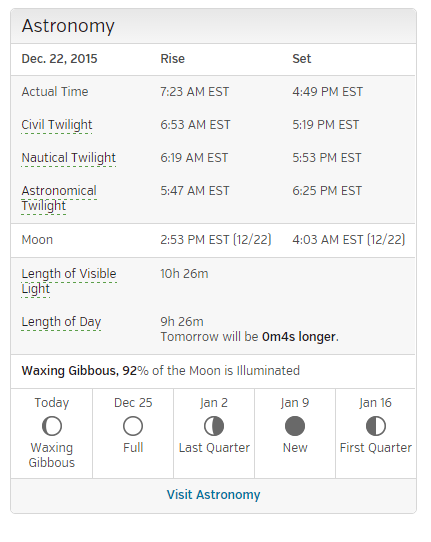
I would like to say that I can feel the darkness receding but the truth is that in my Federally mandated cube farm I’m so cut off from the world’s natural processes that for the first time in a long time the growing dark as we’ve headed toward mid-winter hasn’t had that much impact on me. Yes, even though it’s midnight when I walk out of my office building I’m just so damn glad to be in the “natural” world again it really doesn’t matter. Regardless, here are this year’s charts:

From weatherunderground.com for my specific zip code. Find yours at the same place: www.wunder.com

Archaeoastronomy's visual calendar of the Equinoxes, Solstices and Cross Quarter holidays.

I am hoping by the time the summer solstice rolls around in June that I’ll be able to regularly look out a window and see the day.

Nov
18
2011

Finding the scent

Well, I’m sucking at this NaBloPoMo thing. It’s now the 17th of the month and I’ve only written 10 entries. That means I’ve missed a week’s worth of entries. In some ways I’m surprised by this; it’s not as if I’ve got a wild social life that’s taking up a ton of time. In other ways, it’s pretty much par for the course.

Loathesome Job has had a lot of deleterious effects on my personality over the past 8 months. In order to survive, to keep my spleen from exploding from both astonishment and outrage I’ve had to spend a lot of mental and emotional energy detaching:

  • I have learned not to care about the fact that virtually everyone I work with has a rampant case of not my job-itis.
  • I have learned not to care that the person who is ostensibly in charge of making the websites my group works on good thinks that making the experience pleasant for the user is the same as making sure someone who is blind can access the site at all.
  • I have learned, mostly, to stifle my bullshit alarm when Management sends a note out saying that the IT guy will be around to install webcams on all our computers but it’s not so they can watch us during the work day.
  • I have learned to accept that I’ve been given what is essentially a window watcher job because Management has such a need to control its staff that they’d rather waste my talents than give someone on the “content” side “technical” tasks.

I’ve detached so well that things that used to really bother me merit merely a weary shrug these days. I can’t seem to get exercised about or involved in virtually anything.

It does not help that it is midnight outside at 5pm. It does not help that I work in a 12 ft x 8 ft cubicle jammed into an interior room with 14 other 12 ft x 8 ft cubicles. It does not help that when I do make it out of my office building there is nothing, and I mean nothing, stimulating in the vicinity. It does not help that almost my entire support system, anemic as it is, exists no where near me physically (not to mention the fact that everyone in my support system is dealing with their own problems right now).

Manhunter, 1986

There’s this great scene in the movie Manhunter, in fact it’s the first time we meet Hannibal Lecktor (Brian Cox). Will Graham (William Petersen) has brought the files from the Toothfairy case to Lecktor ostensibly to get the doctor’s opinion on the killer’s motives and methods.

Lecktor realizes that Graham isn’t actually there to get his opinion on the case. No, Graham is there to get the old scent back, to get back into the mindset that allowed him to catch Lecktor in the first place.

I’m afraid that I’ve detached so well that I’ve become detached not only from life but from who I am and what I want. I’m even more afraid that I won’t be able to get my own scent back.

Sep
26
2011

Rockwell had no idea

You are being watched. You might think you aren’t but you are.

I’m not talking about security cameras of which there are an astounding number: Slate.com reported in 2010 on a five year-old study done by the New York Civil Liberties Union which counted 4,176 in Manhattan below 14th street. That’s 4,176 concentrated in one-sixth of the island. The same Slate.com article reported “The initiative [in NYC] is based on London’s Ring of Steel, which launched in the 1990s in response to IRA bombings. Britons may be the most videotaped people on earth. London has some 500,000 security cameras, while Great Britain as a whole has about 4 million.”

Think about that for a minute: that’s 4 million cameras in an area smaller than the state of Oregon. Security cameras aren’t just the province of big cities any more. Speed cameras, toll booth cameras, even cameras at the fast food drive through can all be used to observe your movements. But this isn’t what I mean when I say “you’re being watched.” I mean something even more insidious. I’m talking about your filter bubble.

Wikipedia defines the filter bubble as “…a concept developed by Internet activist Eli Pariser in his book by the same name to describe a phenomenon in which websites use algorithms to selectively guess what information a user would like to see based on information about the user like location, past click behavior and search history. As a result websites tend to show only information which agrees with the user’s past viewpoint.”

Pariser’s book and website provide more insight into not only how Google and other entities track your behavior online but how the smallest interaction with an add, link, or seemingly unrelated site can accrete to form what may or may not be an accurate picture of who you are and how that picture will influence in the future what messages you see.

Contemplate an Internet where ads pop up on unrelated sites simply because you visited a merchant’s website at some point in time.

Or how about a world in which search isn’t neutral but tailored specifically to what the algorithm thinks you want to see.

Imagine a political campaign where the messages are so micro targeted that you never actually get a full picture of the candidate’s positions, only message tailored to your interests designed to sell the candidate to you.

I didn’t notice the filter bubble in effect until after I read Pariser’s book but once I started looking for it I could see it everywhere: when I search for political topics or news stories Google serves me results from particular sources slanted toward what I normally read online and quite often those results are neither the freshest or most complete; when I visit a merchant’s website invariably that merchant’s advertising shows up on other sites powered by Google ads; and then there is the fact that Google reads my gmail.

Over the weekend I emailed a friend/former coworker to follow up on a remark she made to me while we were socializing at dinner on Friday. She highly encouraged me not to just quit my demeaning, frustrating job at which I have been totally marginalized and specifically told that I am not allowed to use anything but the barest range of my skill set. No, she said, make sure you have some place to go to before you leave.

Since there was beer involved, and since I am completely exhausted pretty much all the time now, I wasn’t thinking as quickly as I should so Saturday morning this is part of what I wrote to her:

My point about “just away,” which I was not expressing well thanks to the uberpils, is that if I were in a romantic relationship where I was being gaslighted (I don’t remember things correctly), jerked around (No, I can’t have a clear definition of my role.), marginalized (So, my work assignments are things that no one gives a cr*p about and that offer no value to the American public thereby negating the whole idea of “public service.”), patronized (I’m supposed to take career and technical direction from people that don’t understand the fundamental principles of web communications? Seriously?), and just generally aggravated (I wasn’t kidding: I’ve woken up angry and thinking about work every. single. morning. for the past month. This sh*t is getting old.) on this scale no one would be saying to me “Don’t leave until you’ve found someone else to be with.”

Right after I sent that message gmail served up this advertisement:

Now tell me, how long do you think it’s going to be before I start seeing ads for relationship counselors all over the Internet? I suspect I’ll start seeing them sometime within the week.

If you’re interested in searching where you aren’t tracked try duckduckgo.com or learn visually about how your filter bubble works.

Blog title gleefully swiped from Rockwell’s 1984 single “Somebody’s Watching Me

Sep
01
2011

Eating the strawberry

Human beings are not known for our ability be present. Nor are we known for our ability to see details. We do not approach situations with beginner’s mind – that state of possibilities rather than knowledge.

We tend instead to cling an imagined, romanticized version of the past; we call this nostalgia. We tend to anticipate and extrapolate based on previous experiences which may have only the slightest bit in common with a situation in which we find ourselves. And it is these two actions – clinging and extrapolating – that often cause us to make the worst decisions.

For the past five and a half months I have been working at a job that I loathe. It’s not particularly onerous as jobs go: my life is never in jeopardy while working; my boss isn’t physically abusing me; and I am paid a decent wage for the hours I am expected to work. But other than money, which in this economy is not something to be rejected, this job provides absolutely no rewards:

  • The work is not interesting.
  • I have no autonomy or control over my work flow.
  • I’ve repeatedly asked to use a broader portion of my skill set even going so far as to volunteer to take on massive responsibilities only to be told no because the skills I want to use do not fit management’s narrow definition of my job duties.
  • The physical working conditions are inherently dismal with no privacy, no ventilation, and no access to natural light.
  • My expertise, that for which I was theoretically hired, is consistently disregarded in favor of decisions, when decisions are made at all, that risk nothing and benefit only the few.
  • My bosses’ management style is not management so much as a series of conflicting games with ever changing rules.
  • In the five and a half months I’ve been there five people have left for other jobs

Because of this not merely lack of reward but soul sucking despond, I have found myself lately looking back on my previous job with loving longing and good feelings something for which I have roundly slapped myself.

My previous job at FlounderingNonProfit was filled with conflict:

Once there was a monk being chased by a group of tigers. The monk ran and ran until he found himself at the edge of a cliff. When he looked over he saw a ledge but it held another group of tigers. Then the monk noticed a perfect, ripe strawberry growing in the grass. He reached down, picked it, and ate it.

I am a firm believer in the theory that my job is not my life but because I am so miserable for so many hours in the day my job is taking over my life substituting seething anger at Management’s audacity and SeniorManagement’s inability to see Management’s incompetence for relaxation and enjoyment of my hobbies. Creativity sailed out the window months ago as is clearly evidenced by the gaps between, and the one note theme of, these essays.

My last job was not perfect but it provided me with some intangible rewards I was unaware previously how much I value, and it is those rewards and that value that incline me to ignore its conflicts and to cloak that time in a haze of nostalgia.

The challenge is to see through that nostalgia and to figure out how to apply what I value – autonomy, broad range of tasks that allow me to solve problems creatively instead of just enforcing management’s whims, flexibility in my schedule along the order of “your job is something you do, not necessarily some place you go,” and access to natural light – to not only the job search but to the rest of my life.

The concurrent challenge is to figure out how to be present and eat the strawberry.

Mar
28
2011

Be careful what you wish for

One of the problems I had with Floundering Non-Profit was the fact that it was floundering. It suffered from a bad case of Founder’s Syndrome which meant that new ideas were often rejected without any consideration on their own merits. It also meant that structure, what there was of it, was haphazard at best and often hidden from view; a typical example is the simultaneous lack of any sort of coherent inclement weather policy existing right beside the unwritten policy that all leave needed to be taken in either half-day or full-day increments. It’s not surprising, then, that when I went looking for another job I looked for organizations with more structure. And I thought I had that. Turns out, I have it and I don’t.

I have so much structure at my new job that the IT guy for our group only takes care of hardware problems. For software problems, network issues, or password issues, I have to call the help desk. Allot a minimum of 20 minutes per call.

I have to get my software requests, like having Firefox installed on my machine, approved by our operations group but they don’t actually do anything with the request. It’s then up to me to wheedle, cajole, and plead with the IT help desk to actually install the software. Because yes, it’s important to have a web group that is restricted to using only IE 8.

There is, in turn, so little structure at my new job that we’re a web group serving internal clients yet we have no standard document we can offer them to guide them through the items we’ll need to see in order to approve their design or redesign plans. So…we’re expecting them to meet a standard but giving them virtually no guidance on what that standard is. Is that right?

I have so little structure that an original “request” I ended up getting from one of my internal clients when the e-mail chain was already about 6 message, and 5 carbon-copy addresses, deep consisted of “Here’s the Word doc and the PDF. They’ve been checked for accessibility on our side. They need to be posted.” Not only did this “request” not contain any actual information, it crossed internal groups that shouldn’t have seen it at all in order to get to me.

Because I am having to adjust to so much – new issues, a new role, new colleagues, a new way of doing things – I have been working hard to suppress my incredulity the during the past couple of weeks. I could probably bench press a VW Beetle using only my WTF reflex at this point.

If it sounds like I’m complaining a little bit that’s possibly because I am. The only saving grace at this job is that my co-workers realize things are messed up. But, since the organization we work for is so large, mostly they’ve taken a “what can you do?” attitude toward this problems. For the most part, I’m fine with that. I already know that I’m not going to fix the major problem with most of my clients’ web sites. I’m fully prepared to let that one go.

What I can’t let go, what I absolutely refuse to let go, is a work process that makes sense for me. So in between feeling like I wanted to cry and I wanted to punch something today as I waited until nearly noon to get access to my computer, I started to figure out how to systemize the work requests I’ll be getting from my clients.

After all, they should be used to having to fill out forms by now.

Feb
21
2010

Smile and maybe they won’t notice the apocalypse

Why yes that is Comic Sans MS! How good of you to notice.

I am not by nature a positive person. Chemical imbalance in the brain, what they tell us is the cause of both major and recurrent depression, is to blame for that; personally, I blame puberty but that’s a whole separate discussion. That fact that I am also judged to be “not a positive person” has more to do with unrealistic expectations on the part of society, and particularly the “look at me” society of illusion we seem to be encouraging these days, than with how I actually behave.

When presented with an idea I tend to think ahead, to try to anticipate roadblocks to achieving whatever the stated goal might be. Some of this is directly due to my upbringing – my mother never liked to be caught unprepared for a contingency and raised me to have the same attitude – and some of it is because I am rather goal oriented and I dislike failing to achieve a goal for a preventable reason. In this age of positive psychology and awards for participation, asking questions up front about whether or not we have the resources to achieve a goal, or if we manifestly don’t how we plan on getting them, or whether or not we’re willing to scale back what we want to match the resources we do have is seen as negative, as being “a drag.”

When you combine that brain-depression with all the things that go with it, like insomnia, which exacerbates circular, catastrophic thinking which exacerbates the depression, rinse and repeat, with a training and bent that wants to anticipate obstacles every now and then what you get is a really bad mood. But in an optimism fueled, can-do, think positive, nothing is actually a failure and all you have to do is apologize or play the victim and you can be redeemed world, bad moods are unacceptable. And no where is this more evident than in the world of social networks.

Social networks, for those who have managed to live under a rock for the past three years and have avoided all the media spunk over how this new way of relating is going to change the world and kill privacy, connect you to a vast array of people either by: 1) scraping your address book and sending messages, with or without your permission, to the folks therein, 2) by allowing you to form voluntary connections suggested by previous life events like the school you attended or the presence of a fan page or group that you’ve joined, 3) by looking at your online behavior, like sending e-mail, and just automatically connecting you to the people you already communicate with frequently, or 3) by allowing you to search topics and interests and follow the posts of people you are intrigued by whether they follow your posts or not. These are the connections models for these networks are in order: 1) Quechup (among other spam social networks); 2) Facebook; 3) Google Buzz; and 4) Twitter.

You are directly rewarded for your participation in these networks with recognition from your “friends” who either give you some sort of “like” or a comment on your current status – Michelle is having a relaxing Sunday afternoon; Kim is going jogging for the first time since the baby was born – or most recent posting. Lack of response to something you’ve posted on a social network is the equivalent of sitting down at table in the high school cafeteria and having everyone else get up and move. It is shunning: we don’t like what you have to say so we’re going to ignore you.

And while that may be human nature, after all the axiom that there is no such thing as bad publicity (just ask Tiger Woods) exists for a reason, to ignore the things that we just want to go away, what does it say when we have our media effectively encouraging us to shun our depressed, fat, or lonely friends because these emotions are contagious and might cause us to feel the same thing?

What does this do but force those of us who aren’t always cheerful, who aren’t “having a relaxing Sunday,” to pretend that we are thereby denying genuine human emotion?

I understand that someone who is constantly negative can be a drag, but maybe we need to pay more attention to frequency and a little bit less attention to content. Maybe, just maybe, we need to relearn that the purpose of grouping together into this wonderful thing we call “society” is to create an environment in which all of us don’t have to be strong at the same time. Or maybe we need to grow the fuck up and realize that life isn’t always pretty and happy and that by expecting it, and everyone in it, to be thus we set an unreasonable bar for happiness that turns us into pleasure junkies who have to constantly search for bigger, greater, more joyful experiences just to get any pleasure out of life at all.

Dec
19
2007

Quote of the day

I am a part of all that I have met
- Alfred, Lord Tennyson

Something to remember for those dark times when I’m feeling small: even the littlest thing, a smile, a nod, holding the door for someone, can make a difference.

Nov
25
2007

Mis-connected

Every now and then Postsecret washes up something that has meaning for me. Today just happens to be one of those days.

From weekly Post Secret 25 November 2007

I think maybe life would be easier if it was as OK for “grownups” to be confused or scared as it is for little kids to feel that way. Somewhere along the line we forget as we “master” our world that just because the things that were new and scary when we were three are no longer new and scary doesn’t mean there aren’t other new and scary things out there and that the difference between being three and being “a grownup” is that you keep pushing even when you’re scared. Somewhere along that same line continuing to push evolved into “not OK to be frightened.” There’s something wrong with that.

Jul
22
2007

Jean Paul Sartre’s comic strip

Yep, this pretty much says it all except that I never have the bad hair day part.

6chix20070722.gif

Jan
01
2007

And so we begin again

I can’t say that I’m sorry to see the ass end of 2006: it has been a turbulent and often brutal year for me. Those of us in countries that celebrate the turning of the new year at the end of December often attach great significance to the change. Countless resolutions of varying grades of achievablility will be made today and many of those same resolutions will be broken before the month of January turns.

Despite the significance we attach to the turning of the new year under the Gregorian calendar, January 1st is no better or worse a day to turn a new leaf or to make changes in your life than the fifth of March or the thirteenth of September. Akin to the idea that when the student is ready the teacher will appear is the idea that when you are ready to make change – in your environment, in your way of being or thinking, in your job – is the time to make that change regardless of when we are situated in the year.

All of that said, yes, I have made resolutions, ones which are based on all the lessons I have learned in the past 15 or so months and ones which I hope are achievable and realistic:

Identify and articulate what I want.
If I don’t know what I want I can’t say what I want and if I never say what I want I can never get what I want even if it is only me on whom I am relying to fulfill my wants.

Invest only in the outcomes which truly matter and embrace possibility.
Too often I have found myself invested in a specific outcome only to be disappointed when it did not come to pass. By approaching the bulk of life not invested in any one particular outcome I am embracing the idea that in any given situation there are myriad possible outcomes many of which might actually be enjoyable to me. In this way I open myself up to new, different experiences, decrease the chances that I will be disappointed, and expend my energy only on the outcomes which I truly value.

Take more risks.
Because sometimes not taking the risk is a more wrong move than taking the risk.

Yes, they are big, and yes they are not easily achieved since each one represents a fundamental shift in not just behavior – exercising more, eating better, quitting smoking, etc., etc., ad infinitum – as most resolutions are but more a shift in the way in which I approach the sacred transaction that is my life.

The most important thing that I learned this year I learned in one of those student/teacher moments that comes so unexpectedly that if you’re not paying attention you miss entirely: I learned that I really do want to keep living.

And learning that makes everything else that I experienced this year, both good and not so good, worth it.